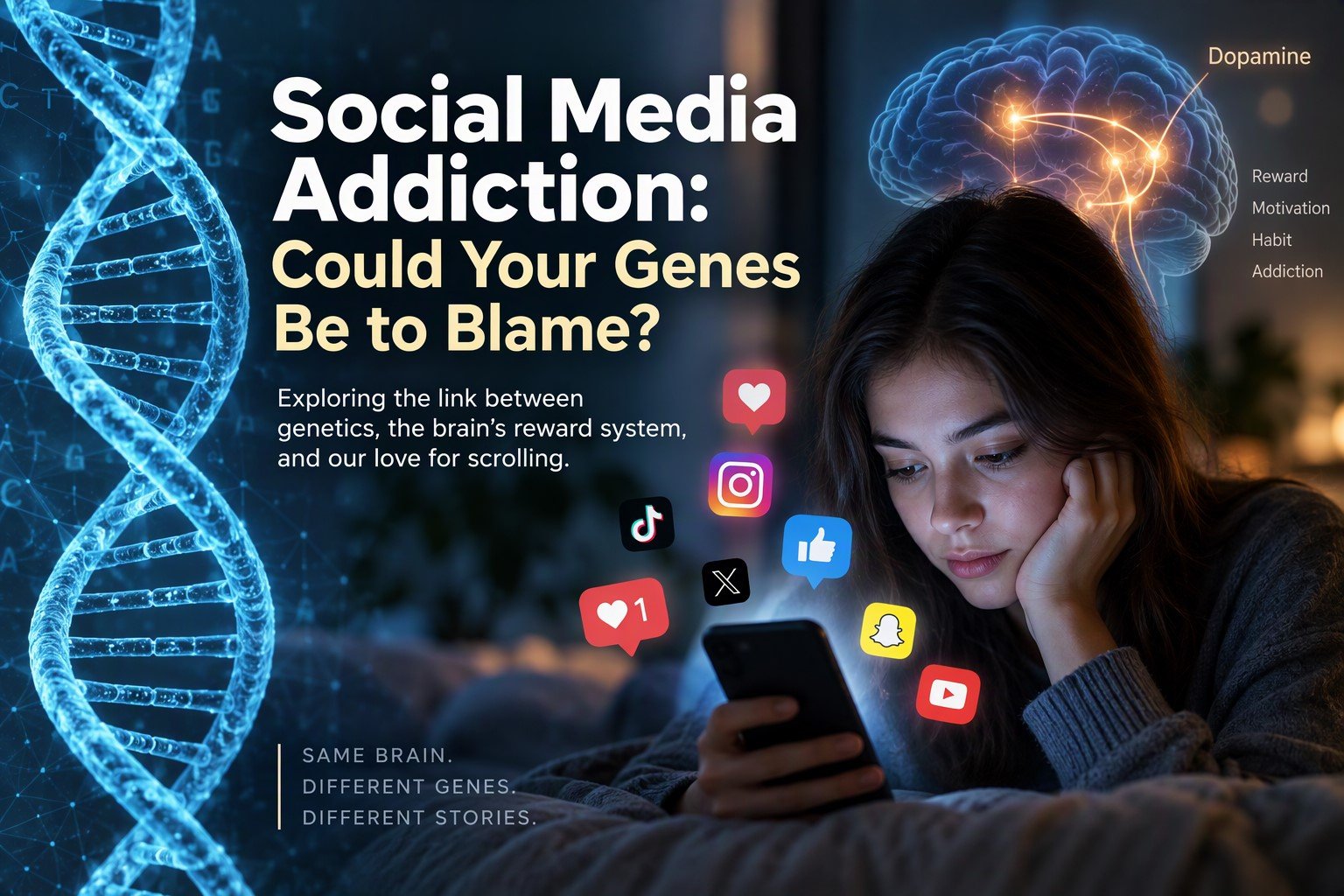
Social media has become an integral part of modern life. For many people, checking notifications, scrolling through feeds, and seeking online validation are routine activities. However, for some individuals, these behaviors can become difficult to control. As concerns about social media addiction continue to grow, researchers are exploring an intriguing possibility: could our genes influence how vulnerable we are to excessive social media use?
Current evidence suggests that genetics may play a role, although social media addiction results from a complex interaction between biology, psychology, and environment.
.
.
Social Media Addiction and the Brain’s Reward System
To understand social media addiction, it is important to first understand how the brain processes rewards.
Every like, comment, share, or notification can activate neural reward pathways involving dopamine, a neurotransmitter associated with motivation and reward-seeking behavior. Consequently, these digital rewards can reinforce repeated engagement with social media platforms.
Furthermore, social media platforms often deliver rewards unpredictably. As a result, users may repeatedly check their accounts in anticipation of new interactions, creating a powerful reinforcement cycle.
.
Social Media Addiction and the DRD2 Gene
Among the genetic factors being investigated in social media addiction, the DRD2 gene has received significant attention.
The DRD2 gene encodes the dopamine D2 receptor, a crucial component of the brain’s reward circuitry. Researchers have previously linked variants of DRD2 to addiction-related behaviors and differences in reward sensitivity.
More recently, a 2024 study examining problematic internet use investigated DRD2 as a potential contributor to risky online behaviors. The findings suggest that genetic differences affecting dopamine signaling may influence how strongly individuals respond to online rewards.
Therefore, DRD2 remains one of the most promising candidate genes associated with vulnerability to excessive digital engagement.
.
Social Media Addiction and ANKK1 Variants
In addition to DRD2, researchers studying social media addiction have examined the ANKK1 gene.
Interestingly, ANKK1 is located close to DRD2 and is believed to influence reward-related behavioral traits. Certain ANKK1 variants have been associated with impulsivity and susceptibility to addictive behaviors.
Consequently, ANKK1 may help explain why some individuals find it much harder than others to disengage from social networking platforms or limit their screen time.
.
Social Media Addiction and the OPRM1 Gene
Another gene that has attracted attention in addiction research is OPRM1.
The OPRM1 gene encodes the mu-opioid receptor, which contributes to reward processing and reinforcement mechanisms in the brain. Variants of OPRM1 have been studied extensively in substance-use disorders and other addictive behaviors.
Although researchers have not yet established a direct relationship between OPRM1 and social media addiction, findings from broader addiction research suggest that this gene may warrant further investigation.
.
Other Genes That May Influence Susceptibility
Scientists suspect that additional genes, including BDNF, DRD4, DAT1, MAOA, and HTR2A, may play roles in susceptibility to social media addiction. These genes influence reward processing, emotional regulation, learning, and impulsivity, all of which can affect how strongly a person responds to the likes, shares, comments, and other forms of digital social reinforcement that characterize modern social platforms.
Social Media Addiction Is Not Determined by Genes Alone
While genetics may contribute to social media addiction, DNA does not determine destiny.
In fact, addiction-related traits are typically influenced by many genes, each contributing only a small effect. At the same time, environmental and psychological factors play major roles. These factors include stress, mental health status, personality traits, family environment, peer influence, and exposure to highly engaging digital platforms.
Therefore, possessing a particular genetic variant does not guarantee that someone will develop social media addiction. Likewise, individuals without these variants can still experience problematic social media use.
.
Social Media Addiction in Teenagers
Research suggests that adolescents may be particularly vulnerable to social media addiction.
During adolescence, the brain regions responsible for impulse control and decision-making are still developing. Meanwhile, social approval and peer acceptance often become especially important. As a result, likes, comments, and online feedback may carry greater emotional significance for teenagers.
Moreover, when genetic predispositions affecting reward sensitivity combine with highly personalized social media algorithms, the risk of problematic use may increase further.
.
The Future Research
Although interest in the genetics of social media addiction is growing, many questions remain unanswered.
Notably, researchers have highlighted that direct genetic studies focused specifically on problematic social media use remain limited. Much of the current evidence comes from studies of internet addiction and other behavioral addictions.
Nevertheless, future investigations may help scientists identify biological risk factors, develop personalized prevention approaches, and better understand why some individuals are more susceptible to compulsive digital behaviors than others.
.
Final Thoughts on Social Media Addiction
The science behind social media addiction is still evolving. However, current evidence suggests that genes involved in dopamine signaling and reward processing, particularly DRD2, ANKK1, and potentially OPRM1, may influence an individual’s susceptibility to problematic social media use.
At the same time, genetics is only one part of a much larger picture. Ultimately, social media addiction emerges from the interaction of biological predispositions, personal experiences, and digital environments. While researchers have not identified a single “social media addiction gene,” the growing field of addiction genetics is helping us better understand why some people may be more vulnerable than others.
.
References
- Rył A, Tomska N, Jakubowska A, et al. Genetic Aspects of Problematic and Risky Internet Use in Young Men: Analysis of ANKK1, DRD2 and NTRK3 Gene Polymorphism. Genes. 2024. [mdpi.com], [ncbi.nlm.nih.gov]
- Tereshchenko SY. Neurobiological Risk Factors for Problematic Social Media Use as a Specific Form of Internet Addiction: A Narrative Review. World Journal of Psychiatry. 2023. [pmc.ncbi.nlm.nih.gov]
- Burhan R, Moradzadeh J. Neurotransmitter Dopamine and Its Role in the Development of Social Media Addiction. Journal of Neurology & Neurophysiology. 2020. [iomcworld.org]
- De D, El Jamal M, Aydemir E, Khera A. Social Media Algorithms and Teen Addiction: Neurophysiological Impact and Ethical Considerations. Cureus. 2025. [pmc.ncbi.nlm.nih.gov]
- Research examining addiction-related genetic variants including DRD2 and OPRM1. [link.springer.com], [pmc.ncbi.nlm.nih.gov]
.
Generated using Microsoft Copilot
.
.
See also
.