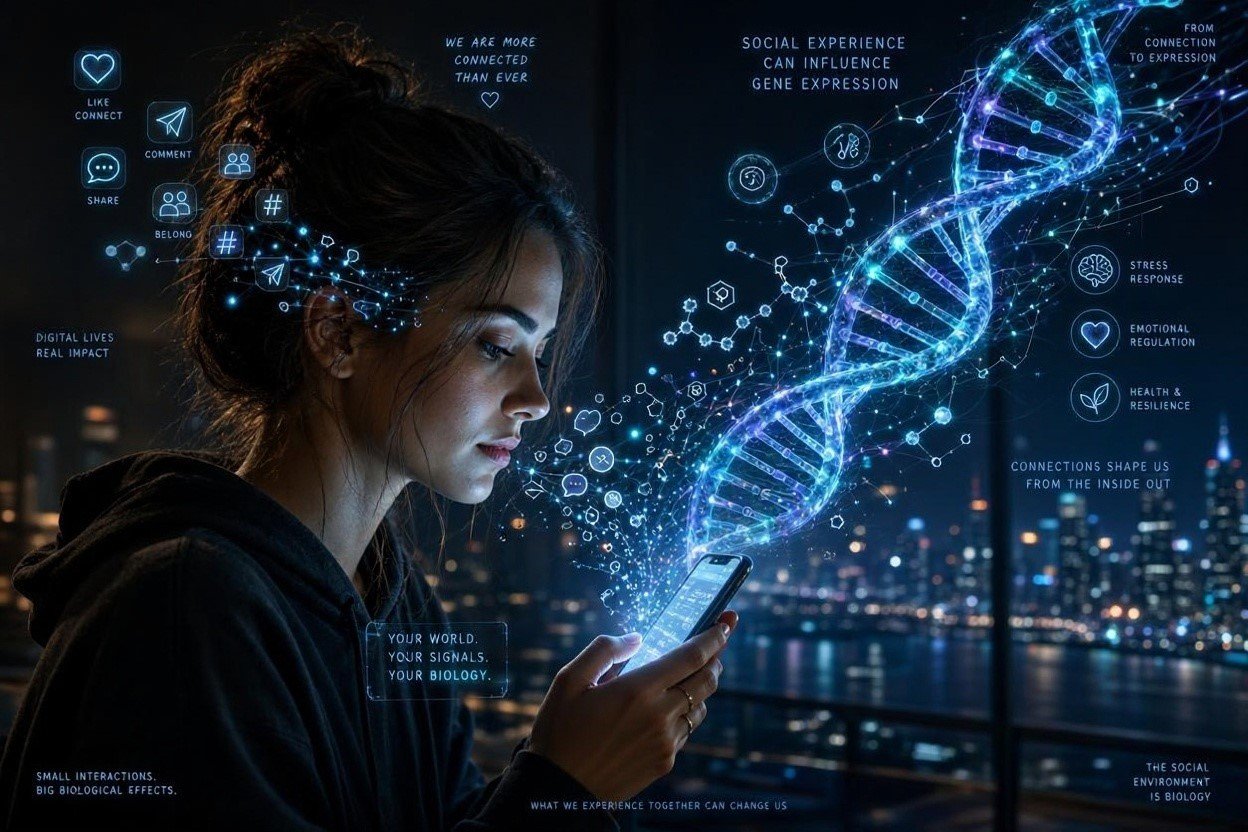
Social media and gene expression may seem like unrelated topics at first glance. However, as scientists continue to explore the biological effects of digital technology, researchers are beginning to investigate whether online behaviors can influence the mechanisms that regulate how genes function.
Although social media cannot change your DNA sequence, growing evidence suggests that factors associated with heavy social media use, such as stress, sleep disruption, and altered reward processing, may affect the biological pathways involved in gene expression and epigenetic regulation.
.
 .
Social Media and Gene Expression: Understanding the Basics
Before discussing social media and gene expression, it is essential to understand what gene expression means.
Your DNA contains thousands of genes that provide instructions for building and maintaining the body. However, not all genes are active at the same time. Gene expression is the process through which cells turn specific genes on or off and use their instructions.
In other words, while your DNA remains largely unchanged, gene activity can vary depending on environmental influences and lifestyle factors.
This is where epigenetics enters the picture.
.
Social Media and Gene Expression: The Role of Epigenetics
When scientists discuss social media and gene expression, they often focus on epigenetics.
Epigenetics refers to biological mechanisms that control gene activity without changing the DNA sequence itself. These mechanisms help the body adapt to environmental conditions and experiences.
Major epigenetic processes include:
- DNA methylation
- Histone modification
- Chromatin remodeling
- Non-coding RNA regulation
Importantly, epigenetic changes can be influenced by:
- Stress
- Sleep quality
- Physical activity
- Nutrition
- Social experiences
Therefore, if social media significantly affects these factors, it could potentially influence pathways involved in gene regulation.
.
Social Media and Gene Expression Through Stress
One of the strongest potential links between social media and gene expression involves stress.
On one hand, social media can facilitate communication and social support. On the other hand, excessive use may contribute to anxiety, social comparison, emotional distress, and information overload.
Researchers studying problematic social media use have highlighted the involvement of stress-related biological systems and neuroendocrine pathways.
Consequently, prolonged psychological stress can activate the hypothalamic-pituitary-adrenal (HPA) axis, increasing levels of cortisol and other stress hormones.
Because chronic stress has already been associated with epigenetic modifications in numerous studies, researchers consider stress a plausible pathway linking social media exposure and changes in gene activity.
.
Social Media and Gene Expression Through Sleep Disruption
In addition to stress, sleep may play a critical role in the relationship between social media and gene expression.
Today, many users spend hours scrolling through social platforms before bed. As a result, they may experience:
- Delayed sleep onset
- Reduced sleep duration
- Irregular sleep schedules
- Poor sleep quality
Researchers have identified sleep and circadian regulation as important biological pathways associated with problematic digital-media use.
Furthermore, sleep is known to influence genes involved in:
- Immune responses
- Metabolism
- Hormone regulation
- Circadian rhythms
Therefore, if excessive social media use contributes to persistent sleep disturbances, it may indirectly affect gene expression patterns.
.
Social Media and Gene Expression Through Dopamine Signaling
Another fascinating aspect of social media and gene expression involves the brain’s reward system.
Social media platforms deliver rewards in the form of:
- Likes
- Comments
- Shares
- Notifications
- Personalized recommendations
As a result, dopamine-related pathways become activated. These pathways are central components of motivation, reinforcement, and reward-based behavior.
Likewise, reviews of problematic social media use consistently identify dopamine signaling as a key biological mechanism.
Because addiction research has shown that repeated reward-system activation can influence molecular processes within the brain, scientists are increasingly interested in whether intensive digital engagement could contribute to epigenetic adaptations over time.
.
Social Media and Gene Expression: Can Online Social Experiences Matter?
Equally important, online social interactions may influence the connection between social media and gene expression.
Positive interactions can provide:
- Emotional support
- Community belonging
- Social connection
- Educational opportunities
However, negative experiences such as cyberbullying, harassment, and chronic social comparison may increase psychological stress.
Scientists already know that social environments can affect biological systems involved in gene regulation. Therefore, digital social environments may deserve similar attention as researchers continue investigating the biological consequences of online behavior.
.
What Current Research Says About Social Media and Gene Expression
At present, there is no evidence that simply using Facebook, Instagram, TikTok, or X directly changes human DNA.
Nevertheless, research suggests that excessive digital-media use may influence several biological systems that are already known to interact with gene regulation, including:
- Stress-response pathways
- Dopamine signaling
- Sleep and circadian regulation
- Emotional regulation mechanisms
Recent reviews have identified these pathways as important topics for future investigation.
Moreover, researchers note that genetic and epigenetic studies focused specifically on problematic social media use remain limited and require additional investigation.
.
Future Research
Looking ahead, the field of social media and gene expression is likely to expand significantly.
Future studies may explore:
- DNA methylation in heavy social media users
- Epigenetic biomarkers associated with digital addiction
- Long-term effects of social-media-related stress
- Gene-environment interactions affecting online behaviors
- Whether reducing problematic social media use leads to measurable biological changes
Consequently, researchers may eventually uncover new links between digital lifestyles and human biology.
.
Final Thoughts
The relationship between social media and gene expression remains an emerging area of research. Current evidence indicates that social media does not change your DNA sequence. However, excessive social media use may influence stress, sleep quality, emotional regulation, and reward-related pathways, all of which can interact with mechanisms involved in gene expression and epigenetic regulation.
Ultimately, while scientists cannot yet conclude that social media directly alters gene expression, the growing body of research suggests that our digital habits may affect biological processes in ways we are only beginning to understand.
.
References
- Tereshchenko SY. Neurobiological Risk Factors for Problematic Social Media Use as a Specific Form of Internet Addiction: A Narrative Review. World Journal of Psychiatry. 2023. [pmc.ncbi.nlm.nih.gov]
- Boumpalou E, Papageorgiou A, Damianos G, Sergentanis TN, Tsitsika AK. Genetic Polymorphisms and Endocrine Pathways Associated with Problematic Digital-Media Use and Gaming Disorder: A Narrative Review. Journal of Personalized Medicine. 2026. [pubmed.ncb…lm.nih.gov], [mdpi.com]
- De D, El Jamal M, Aydemir E, Khera A. Social Media Algorithms and Teen Addiction: Neurophysiological Impact and Ethical Considerations. Cureus. 2025. [pmc.ncbi.nlm.nih.gov]
- Rył A, Tomska N, Jakubowska A, Ogrodniczak A, Palma J, Rotter I. Genetic Aspects of Problematic and Risky Internet Use in Young Men—Analysis of ANKK1, DRD2 and NTRK3 Gene Polymorphism. Genes. 2024. [pmc.ncbi.nlm.nih.gov], [mdpi.com]
.
.
Generated using Microsoft Copilot
.
.
See also
Social Media Addiction: Could Your Genes Be to Blame?
.