The Optogenetics Breakthrough marks a turning point in neuroscience and ophthalmology. By harnessing light‑sensitive proteins to reprogram retinal cells, scientists are restoring partial vision to people once considered permanently blind. This innovative therapy merges gene engineering with optical technology, offering hope to millions affected by degenerative eye diseases such as retinitis pigmentosa.
.
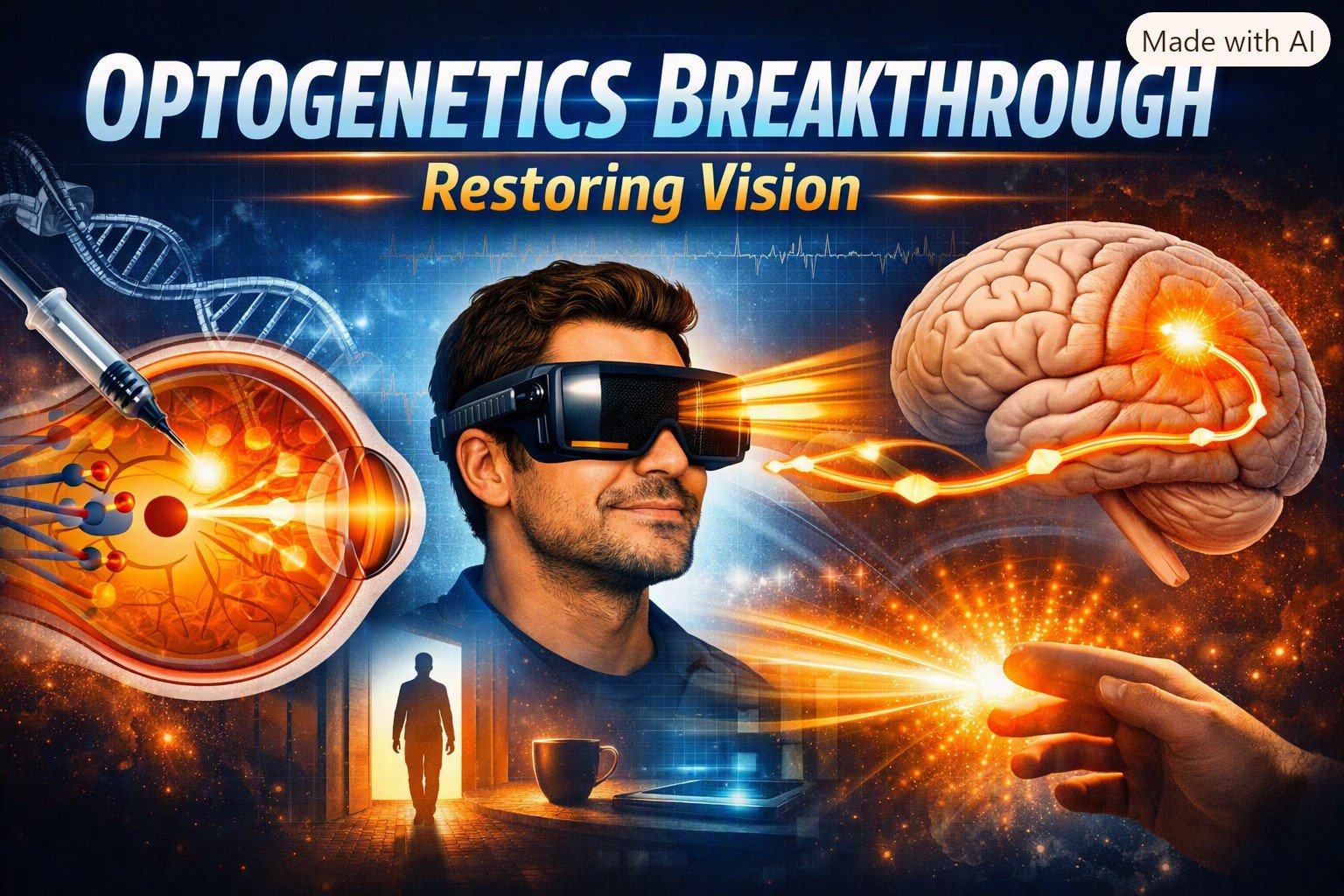
💡 What Is the Optogenetics Breakthrough?
The Optogenetics Breakthrough refers to the use of light‑responsive proteins introduced via gene therapy to make retinal cells sensitive to light again. Instead of repairing damaged photoreceptors, researchers activate surviving ganglion cells using proteins like ChrimsonR, derived from algae.
- Key Insight: Clinical trials show measurable improvement in light perception and object detection.
- Impact: Patients regained the ability to locate doorways and count objects after decades of blindness.
👁️ How the Optogenetics Breakthrough Works
- Gene Therapy Injection – A viral vector delivers the light‑sensitive gene into retinal cells.
- Smart Goggles Interface – Goggles capture images and project amber light pulses onto the retina.
- Neural Transmission – Reprogrammed cells send signals through the optic nerve to the brain.
- Visual Cortex Activation – The brain interprets these signals as shapes and motion.
This process bypasses damaged photoreceptors and directly stimulates surviving retinal neurons — the core mechanism behind the Optogenetics Breakthrough.
🧪 Clinical Results and Data
According to recent studies on the Optogenetics Breakthrough:
- 70% of participants showed improved light sensitivity.
- 40% could locate objects or follow lines using goggles.
- No major side effects were reported in long‑term follow‑ups.
These results confirm that optogenetic therapy is both safe and effective for late‑stage blindness.
⚙️ Challenges and Future Directions
While the Optogenetics Breakthrough is promising, challenges remain:
- Low visual resolution limits reading and facial recognition.
- Dependence on external goggles for light amplification.
- Need for improved gene delivery systems for sustained expression.
Future research aims to enhance color perception and integrate AI‑powered goggles for real‑time image processing.
🧭 Conclusion
The Optogenetics Breakthrough represents a new era in vision restoration. By merging light‑based gene therapy with neural reprogramming, scientists are not only restoring sight but redefining the boundaries of neuro‑rehabilitation. As technology advances, the dream of full visual recovery moves closer to reality.
📚 References
- Sahel, J. A., Boulanger-Scemama, E., Pagot, C., Arleo, A., Galluppi, F., Martel, J. N., … & Roska, B. (2021). Partial recovery of visual function in a blind patient after optogenetic therapy. Nature Medicine, 27(7), 1223–1229.
https://doi.org/10.1038/s41591-021-01351-4 - Simunovic, M. P., Shen, W., Lin, J. Y., Protti, D. A., Lisowski, L., & Gillies, M. C. (2019). Optogenetic approaches to vision restoration. Experimental Eye Research, 178, 15–26.
https://doi.org/10.1016/j.exer.2018.09.003 - Borchert, G. A., Shamsnajafabadi, H., Xue, K., MacLaren, R. E., De Silva, S. R., & Cehajic-Kapetanovic, J. (2026). Functional methods for evaluating the efficacy of retinal optogenetic therapy for vision restoration. Frontiers in Neuroscience, 20, 1812539.
https://doi.org/10.3389/fnins.2026.1812539 - Kaušyla, K., & Balčiūnienė, V. J. (2026). Optogenetics in advanced retinal degeneration: A systematic literature review and metaanalysis. Journal of Medical Sciences, 14(2), 2–19. https://doi.org/10.53453/ms.2026.4.1
This is a remarkable milestone for late-stage retinitis pigmentosa. Bypassing lost photoreceptors to directly stimulate downstream ganglion cells is a brilliant paradigm shift.