Optogenetics Nobel Prize Shines on Neuroscience. The 2026 Nobel Prize in Physiology or Medicine was awarded to Karl Deisseroth, Peter Hegemann, and Georg Nagel for their pioneering work on optogenetics—a revolutionary technique that uses light to control nerve cell activity. This breakthrough has transformed neuroscience, offering unprecedented insights into how brain circuits govern memory, emotion, and disease.
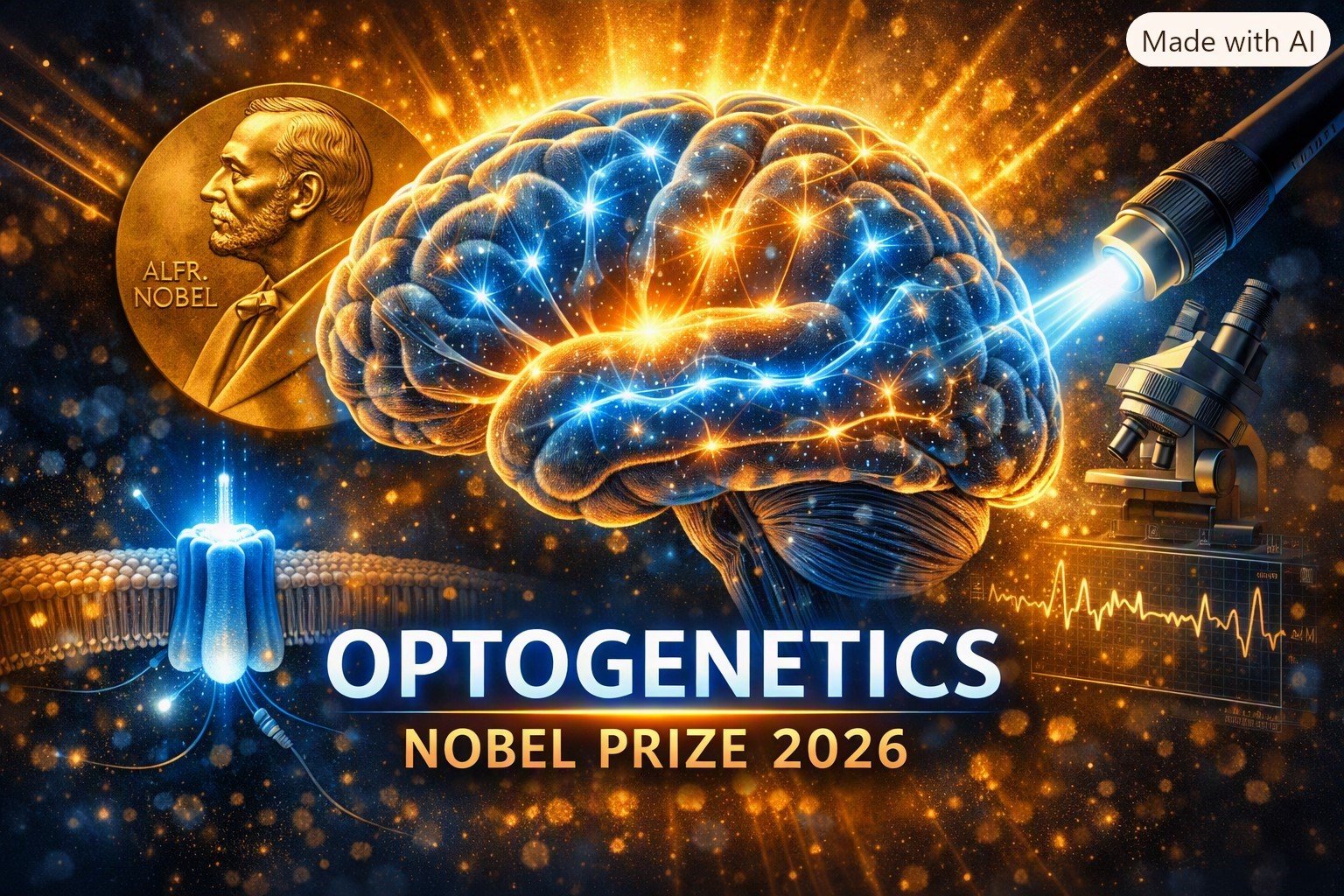
What is Optogenetics Nobel Prize About?
Optogenetics combines genetics and optics to manipulate neurons with millisecond precision. By harnessing channelrhodopsins—light-sensitive proteins discovered in algae—scientists can activate or silence specific brain cells. This Nobel Prize recognizes the leap from basic discovery to a tool that is reshaping modern neuroscience.
Why Optogenetics Nobel Prize Matters
- 🧠 Precision Research: Enables direct control of brain circuits.
- 👁️ Medical Potential: Early trials explore restoring vision in blind patients.
- ⚡ Innovation: Opens new pathways for treating neurological and psychiatric disorders.
The Laureates Behind Optogenetics Nobel Prize
- Peter Hegemann – Discovered channelrhodopsins in algae.
- Georg Nagel – Demonstrated their ability to make other cells light-sensitive.
- Karl Deisseroth – Applied them to neurons, creating the field of optogenetics.
Together, their work has revolutionized how scientists study the brain.
Future of Optogenetics Research
While clinical applications are still emerging, optogenetics holds promise for:
- Vision restoration therapies.
- Understanding complex brain disorders like Parkinson’s and depression.
- Developing next-generation brain–machine interfaces.
References & External Links
For further reading:
Final Note
The Optogenetics Nobel Prize 2026 is more than an award—it’s a recognition of a discovery that is reshaping neuroscience and opening doors to therapies once thought impossible.
See also: What is optogenetics?
Pingback: Optogenetics Breakthrough Restores Sight - Bioinformatics Hub
An exceptionally well-deserved recognition! While the foundational discoveries involving channelrhodopsins were revolutionary on their own, seeing how this technique has matured from basic neurophysiology into a tangible pathway for translational medicine—especially vision restoration and neural prosthetics—is truly inspiring.