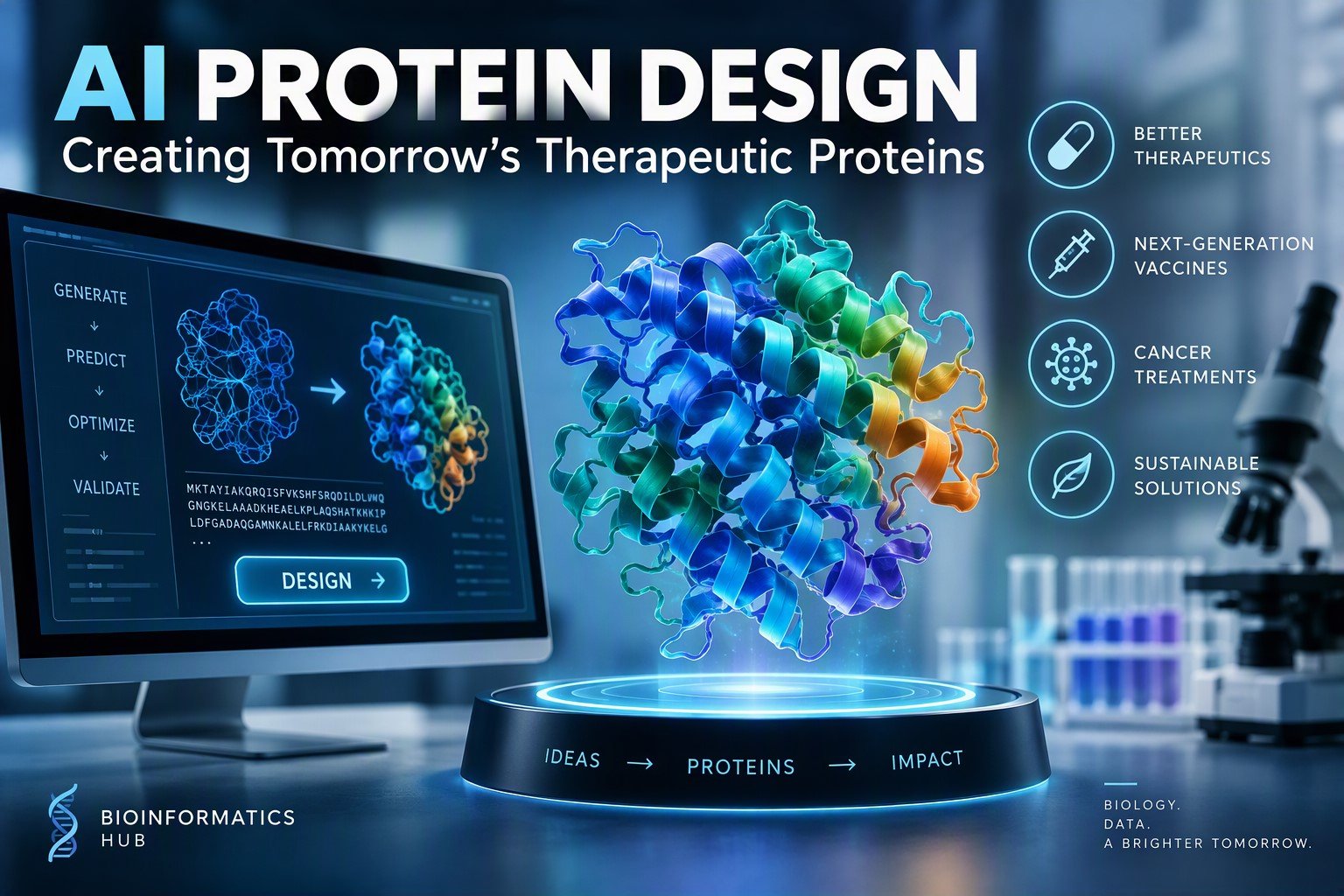
Artificial intelligence (AI) protein design is rapidly transforming biotechnology. Instead of spending years searching for naturally occurring proteins with useful properties, researchers can now use AI to design entirely new proteins from scratch. As a result, the development of novel therapeutics, vaccines, enzymes, and biomaterials is becoming faster and more precise than ever before.
.
.
However, AI protein design is not simply about predicting protein structures. Increasingly, advanced models are helping scientists create proteins that have never existed in nature while still performing specific biological functions. This shift could redefine drug discovery and synthetic biology in the coming decades.
.
What Is AI Protein Design?
AI protein design refers to the use of machine learning and deep learning models to create proteins with desired structures and functions. Traditional protein engineering typically relies on iterative laboratory experiments and random mutagenesis. Meanwhile, AI-driven methods can explore millions of possible protein sequences computationally before any laboratory validation occurs.
These models learn patterns from vast databases of known protein sequences and structures. They can then generate entirely new proteins optimized for specific goals, such as:
- Binding a disease-associated target
- Catalyzing industrial reactions
- Delivering therapeutic molecules
- Improving vaccine responses
- Enhancing protein stability
Consequently, researchers can focus laboratory resources on the most promising candidates rather than testing thousands of random variants.
.
Why AI Protein Design Matters
Proteins perform nearly every biological function within living organisms. They act as enzymes, signaling molecules, antibodies, and structural components. Therefore, designing custom proteins opens opportunities across medicine, agriculture, and industry.
Some potential benefits include:
Faster Drug Discovery
Drug development often takes more than a decade. AI protein design can dramatically reduce the time required to identify therapeutic candidates.
Improved Therapeutic Proteins
Scientists can optimize proteins for greater stability, reduced side effects, and enhanced efficacy.
Personalized Medicine
Future therapies may be tailored to individual genetic profiles using AI-generated protein designs.
Novel Biological Functions
Researchers can design proteins capable of performing tasks not found in nature, expanding the possibilities of synthetic biology.
.
How AI Protein Design Works
The workflow generally involves several key steps:
1. Learning Biological Patterns
AI models are trained using large datasets containing protein sequences and experimentally determined structures.
2. Generating Candidate Proteins
Generative AI systems create new protein sequences predicted to satisfy specific design requirements.
3. Structure Prediction
Tools such as AlphaFold and related models assess whether the designed sequence can fold into the desired three-dimensional structure.
4. Experimental Validation
Scientists synthesize the most promising candidates and test them in the laboratory.
5. Optimization
Experimental results are fed back into the design cycle, improving future predictions.
As a result, researchers can continuously refine protein performance through an iterative AI-assisted process.
.
Breakthroughs Driving AI Protein Design
Several technological advances have accelerated progress in AI protein design.
Generative Models
Generative neural networks can create novel protein sequences that maintain structural stability while enabling new functions.
Diffusion-Based Protein Design
Inspired by image-generation technologies, diffusion models are becoming powerful tools for constructing highly customized protein structures.
Large Biological Foundation Models
These systems learn general biological relationships from enormous datasets and can be adapted for specialized protein-design tasks.
Structure Prediction Revolution
Accurate structure prediction has significantly reduced one of the major barriers to protein engineering.
.
Applications of AI Protein Design
Therapeutic Antibodies
AI can optimize antibodies for improved binding affinity and reduced immunogenicity.
Vaccine Development
Researchers can design protein antigens capable of eliciting stronger and more targeted immune responses.
Cancer Treatment
Customized proteins may improve tumor targeting and enhance immunotherapy approaches.
Industrial Biotechnology
AI-designed enzymes can increase efficiency in manufacturing, food production, and environmental applications.
Sustainable Solutions
Novel proteins could support carbon capture, waste degradation, and renewable bio-based production systems.
.
Challenges Facing AI Protein Design
Despite impressive progress, several challenges remain.
Experimental Validation Is Essential
Computational predictions must still be confirmed through laboratory testing.
Biological Complexity
Living systems involve interactions that remain difficult to model accurately.
Safety Considerations
Engineered proteins require rigorous evaluation before clinical or industrial deployment.
Data Limitations
Many biological functions remain poorly characterized, limiting model performance in certain domains.
Nevertheless, continuous improvements in biological datasets and AI architectures are steadily overcoming these obstacles.
.
The Future of AI Protein Design
The future of AI protein design appears remarkably promising. Researchers are moving beyond predicting structures toward engineering proteins with highly specialized functions. Meanwhile, advances in generative AI, synthetic biology, and high-throughput experimentation are creating a powerful innovation ecosystem.
In the coming years, AI-designed proteins may contribute to personalized therapeutics, next-generation vaccines, environmentally friendly manufacturing, and entirely new categories of biological products. What once required years of trial and error is increasingly becoming a process guided by intelligent algorithms and precise computational design.
.
Conclusion
AI protein design represents one of the most exciting developments in modern biotechnology. By combining machine learning, structural biology, and protein engineering, scientists can create therapeutic and industrial proteins faster than ever before. As the technology matures, AI-generated proteins could become a cornerstone of future medicine and synthetic biology, opening possibilities that were unimaginable only a few years ago.
.
References
- Jumper J, Evans R, Pritzel A, et al. Highly Accurate Protein Structure Prediction with AlphaFold. Nature. https://www.nature.com/articles/s41586-021-03819-2
- Baek M, DiMaio F, Anishchenko I, et al. Accurate Prediction of Protein Structures and Interactions Using RoseTTAFold. Science. https://www.science.org/doi/10.1126/science.abj8754
- Watson JL, Juergens D, Bennett NR, et al. De Novo Design of Protein Structure and Function with RFdiffusion. Nature. https://www.nature.com/articles/s41586-023-06415-8
- Nature Reviews Drug Discovery. Artificial Intelligence in Drug Discovery and Protein Engineering. https://www.nature.com/nrd/
- DeepMind AlphaFold Research. https://deepmind.google/technologies/alphafold/
.
.
.
Generated using Microsoft Copilot
.
.
See also
.
.