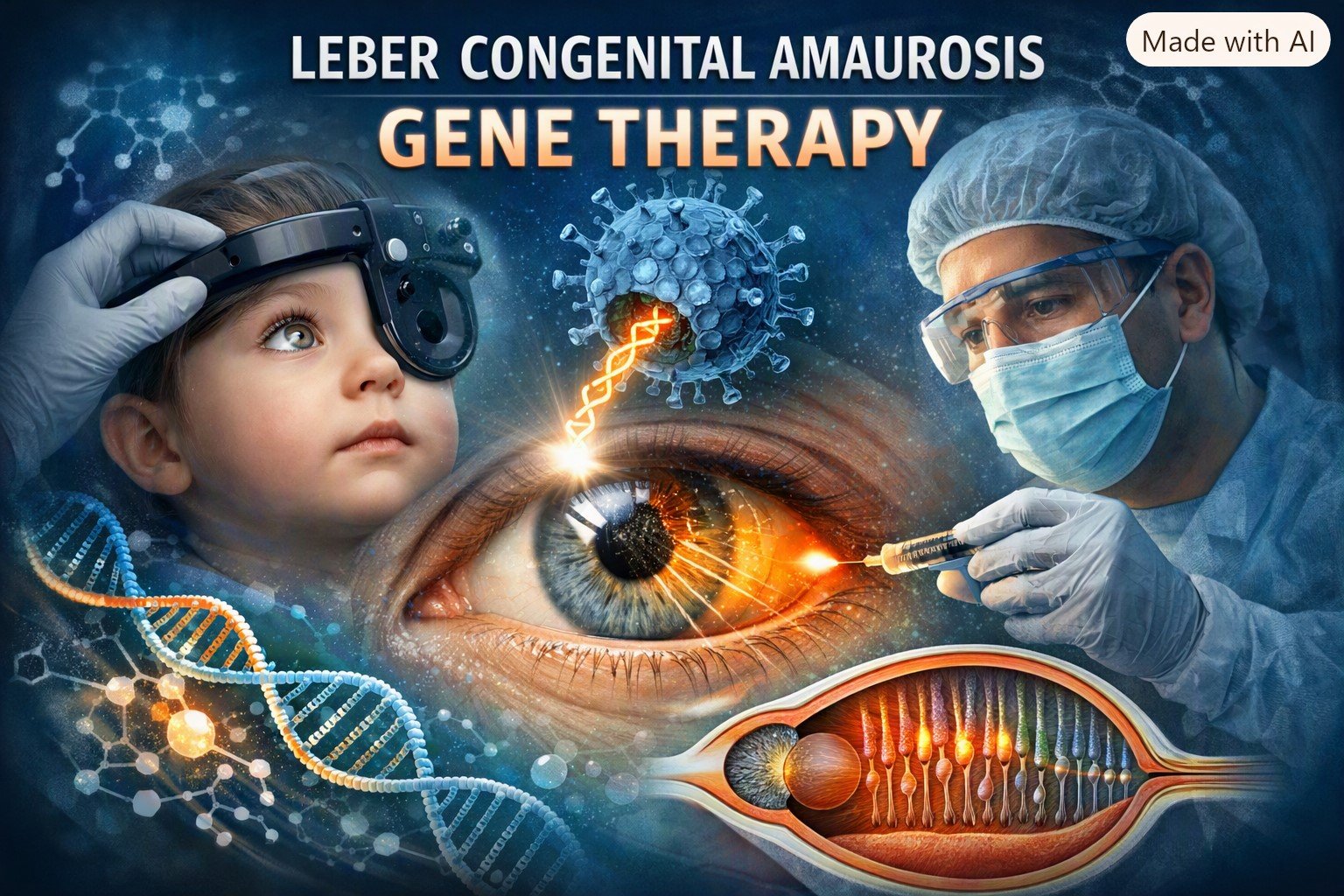
Leber Congenital Amaurosis is at the forefront of gene therapy research, with recent advances offering hope to children born blind. Cutting‑edge treatments targeting GUCY2D (LCA1), AIPL1 (LCA4), and KCNJ13 (LCA16) mutations are showing remarkable progress in restoring vision and improving retinal function.
.
.
.
🧬 What is Leber Congenital Amaurosis?
- Definition: A group of rare inherited retinal diseases causing severe vision loss from birth.
- Genetics: Mutations in more than 25 genes disrupt photoreceptor or retinal pigment epithelium function.
- Impact: Infants often present with nystagmus, poor pupillary response, and progressive blindness.
.
🔑 Leber Congenital Amaurosis Gene Therapy
LCA1 – GUCY2D
- Therapy: ATSN‑101 (Atsena Therapeutics).
- Method: AAV vector delivers functional GUCY2D.
- Results: Patients showed lasting improvements in light sensitivity for 3+ years.
- Next Step: Phase 3 trial planned for late 2026.
.
LCA4 – AIPL1
- Therapy: AAV‑based gene therapy (UK clinical trial).
- Method: Functional AIPL1 delivered to retinal cells.
- Results: Four children treated; treated eyes improved in light perception, while untreated eyes deteriorated.
- Status: Phase 1/2 trial, early but promising.
.
LCA16 – KCNJ13
- Therapy: ACE‑tRNA therapy (University of Wisconsin–Madison).
- Method: Engineered tRNA overrides premature stop codons, restoring Kir7.1 protein.
- Results: ~40% protein restoration in patient‑derived cells; improved retinal function in mice.
- Status: Preclinical, moving toward human trials.
.
📊 Leber Congenital Amaurosis Gene Therapy Comparison
| Therapy | Target Gene | Subtype | Delivery Method | Clinical Status |
|---|---|---|---|---|
| ATSN‑101 | GUCY2D | LCA1 | AAV vector | Phase 3 planned |
| AIPL1 therapy | AIPL1 | LCA4 | AAV vector | Phase 1/2 trial |
| ACE‑tRNA | KCNJ13 | LCA16 | HDAd vector | Preclinical |
⚠️ Challenges Ahead
- Durability: Long‑term restoration beyond 5 years under study.
- Accessibility: High costs and surgical delivery limit global reach.
- Resolution: Current therapies restore basic vision, but fine detail recognition remains limited.
- Ethics: Genetic interventions in children require careful oversight.
.
📚 References
Safety and efficacy of ATSN-101 in patients with Leber congenital amaurosis caused by biallelic variants in GUCY2D (LCA1): Durability through 3 years post-treatment
.
.
Generated using Microsoft Copilot
.
.
See also:
Gene Therapy for Congenital Blindness: Latest Breakthroughs in 2026
Optogenetics Breakthrough Restores Sight
What is it about a new gene therapy that restored vision to a boy born blind?
.
.