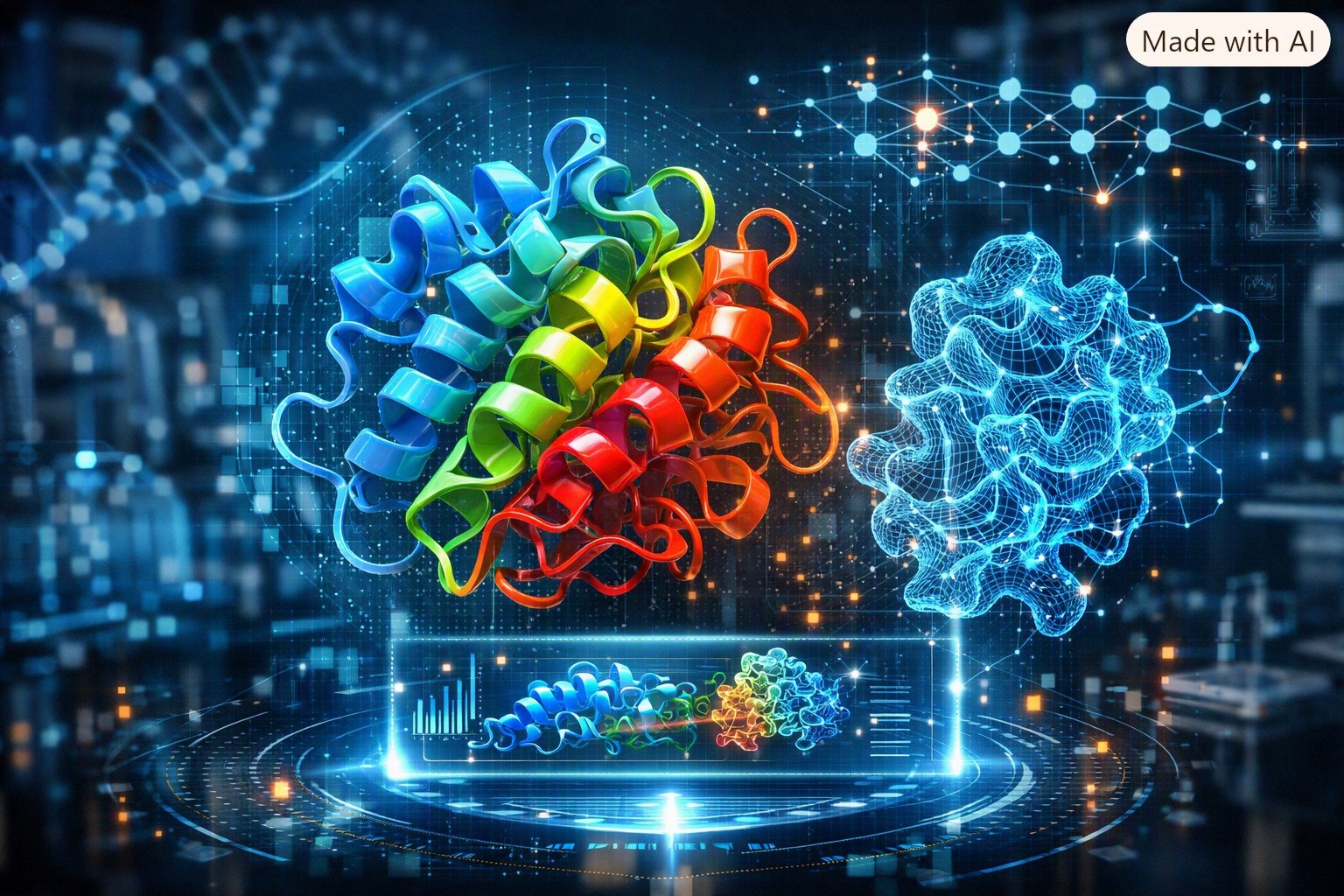
AI-Powered Protein Folding: Beyond AlphaFold
  • Post last modified:2026-10-22
  • Post comments:0 Comments

AI-Powered Protein Folding has transformed bioinformatics, reshaping how scientists understand protein structures and accelerating breakthroughs in drug discovery and molecular biology. AlphaFold was the catalyst, but today a new generation of AI models is pushing protein folding research into uncharted territory.

.

AI-Powered Protein Folding

.

AI-Powered Protein Folding in Context

AlphaFold’s landmark achievement demonstrated that deep learning could predict protein structures with remarkable accuracy, solving a decades‑long challenge in structural biology. This breakthrough underscored why protein folding is central to understanding cellular processes, disease mechanisms, and therapeutic design.

 .

AI-Powered Protein Folding Tools Emerging

Beyond AlphaFold, models such as RoseTTAFold and ESMFold are expanding the toolkit available to researchers. RoseTTAFold All‑Atom enables modeling of complex biomolecular assemblies, while ESMFold leverages large language models trained on protein sequences to predict structures at scale. Together, these tools represent a new wave of AI‑driven structural biology.

.

AI-Powered Protein Folding Applications

The applications are vast:

  • Drug Discovery: Accelerating structure‑based drug design.
  • Enzyme Engineering: Creating novel enzymes for industrial and medical use.
  • Synthetic Biology: Designing proteins for bio‑manufacturing and therapeutics.
  • Precision Medicine: Tailoring treatments based on structural insights into patient‑specific proteins.
.

AI-Powered Protein Folding Challenges

Despite progress, challenges remain. Computational costs are high, accuracy varies for complex assemblies, and ethical concerns arise around the use of AI in biomedical research. Addressing these issues will be critical for responsible deployment of these technologies.

.

AI-Powered Protein Folding Future Outlook

The future lies in hybrid pipelines that integrate AI predictions with wet‑lab experiments. By combining computational speed with experimental validation, researchers can accelerate discoveries in genomics, proteomics, and drug development.

.

.


.
.
Generated using Microsoft Copilot
.
.

See also:

AI Tools Transforming Bioinformatics Research

How To Best Employ Bioinformatics In Medicine

How to best employ AI in medicine?

How To Best Employ Artificial Intelligence In Bioinformatics


.
.

Leave a Reply