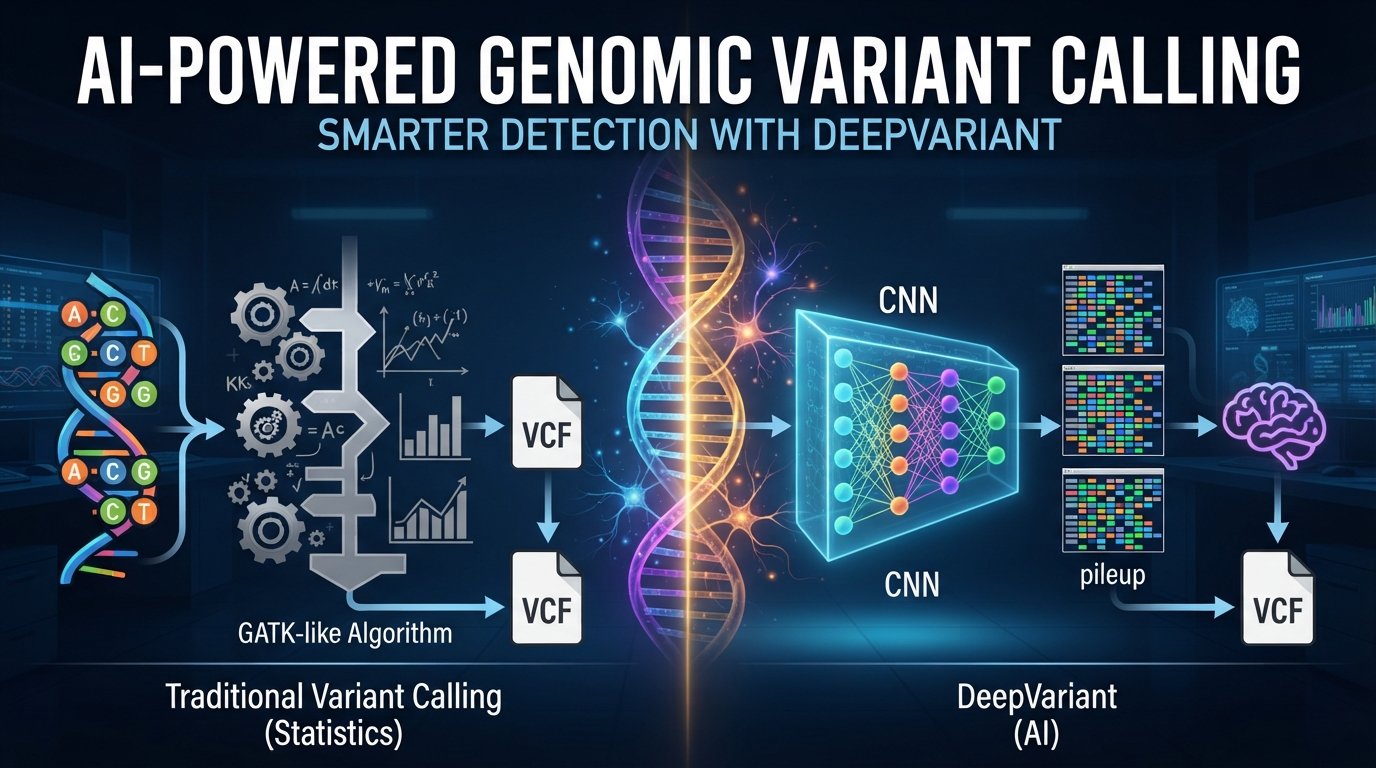
Understanding the human genome requires identifying the unique differences in our DNA. For years, bioinformaticians have relied on complex statistical models to identify these genetic mutations. However, a major shift is happening in the industry through AI-powered genomic variant calling. By treating genetic sequencing data as an image processing problem, Google’s DeepVariant has revolutionized how we detect single-nucleotide polymorphisms (SNPs) and small insertions/deletions (indels), paving the way for highly accurate precision medicine.
.
.
The Evolution of Variant Calling: From Statistics to Deep Learning
Traditionally, identifying genetic variants meant using tools like GATK (Genome Analysis Toolkit). These pipelines rely on sophisticated, hand-crafted statistical models to look at sequencing reads and determine whether a discrepancy is a true biological mutation or just a sequencing error.
While highly effective, these traditional methods often struggle with:
-
- Hard-to-read genomic regions (like highly repetitive sequences)
- Context-dependent errors unique to specific sequencing technologies
- Heavy manual calibration and filtering steps
DeepVariant changes the game by bypassing traditional statistics. Instead, it utilizes a Convolutional Neural Network (CNN)—the same type of deep learning architecture used for facial recognition and autonomous driving—to achieve AI-powered genomic variant calling with superior accuracy.
How DeepVariant Works: Transforming DNA into Images
DeepVariant’s approach is brilliantly simple yet incredibly powerful. It transforms the task of variant calling into an image classification problem through three core steps:
[ Sequencing Reads ] ──> [ Make Images (Pileups) ] ──> [ Call Variants (CNN) ] ──> [ Output VCF ]
-
- Make Examples: The tool takes the aligned sequencing reads (BAM/CRAM files) and a reference genome. It translates this text-based data into visual “pileup” images. Different bases (A, C, T, G), qualities, and strands are encoded as different pixel channels or colors.
- Call Variants: These images are fed into a deeply trained CNN (originally based on Google’s Inception architecture). The network analyzes the visual patterns in the pileup to determine the most likely genotype at any given position.
- Postprocess Variants: The neural network’s classifications are converted back into a standard Variant Call Format (VCF) file.
Why Choose AI-Powered Genomic Variant Calling?
Switching to deep learning-based workflows offers massive advantages for modern bioinformatics pipelines:
1. Unmatched Accuracy Across Sequencing Platforms
Because DeepVariant learns directly from data rather than rigid expert rules, it adapts incredibly well to different sequencing technologies. Whether you are working with Illumina short reads, Pacific Biosciences (PacBio) HiFi long reads, or Oxford Nanopore (ONT) data, AI-powered genomic variant calling automatically adjusts to the specific error profiles of each platform.
2. Exceptional Performance in “Difficult” Regions
Traditional callers often falter in homopolymer runs or highly repetitive regions of the genome. DeepVariant’s visual pattern recognition excels at differentiating true biological variants from systematic sequencing artifacts, significantly lowering false-positive rates.
3. No Manual Hard-Filtering Required
Traditional workflows require extensive Variant Quality Score Recalibration (VQSR) or manual hard-filtering thresholds. DeepVariant replaces these complex, subjective steps with a highly accurate, automated probability score generated directly by the neural network.
Implementing DeepVariant in Your Bioinformatics Pipeline
Integrating DeepVariant into your infrastructure is straightforward, thanks to excellent open-source support and containerization.
-
- Docker & Singularity: Google provides officially supported Docker containers, allowing you to run DeepVariant locally or on a high-performance computing (HPC) cluster with a single command.
- Cloud Integration: DeepVariant is optimized for major cloud platforms, including Google Cloud Platform (GCP) via the Cloud Life Sciences API, Amazon Web Services (AWS), and Azure.
- Hardware Acceleration: To speed up computation times, DeepVariant supports GPU acceleration (via NVIDIA GPUs), which dramatically reduces the time required to process whole-genome sequencing (WGS) datasets.
The Future of Bioinformatics is Intelligent
The integration of machine learning into genomics is no longer a futuristic concept—it is the current gold standard. Utilizing AI-powered genomic variant calling via DeepVariant allows researchers and clinicians to extract cleaner, more reliable data from their sequencing runs. As sequencing throughput continues to grow globally, relying on AI to interpret our DNA will be essential to unlocking the next generation of discoveries in oncology, rare disease diagnostics, and personalized medicine.
References
- Poplin, R., Chang, P. C., Alexander, D., Schwartz, S., Colthurst, T., Ku, A., Newburger, D., Dijamco, J., Nguyen, N., Afshar, P. T., Gross, S. S., Dorfman, L., McLean, C. Y., & DePristo, M. A. (2018). A universal SNP and small-indel variant caller using deep neural networks. Nature Biotechnology, 36(10), 983–987. doi.org.
- DePristo, M., & Poplin, R. (2017, December 4). DeepVariant: Highly accurate genomes with deep neural networks. Google Research. https://research.google/blog/deepvariant-highly-accurate-genomes-with-deep-neural-networks/
- Bisoi, A. V., & Ramsundar, B. (2024). A modular open source framework for genomic variant calling. arXiv. doi.org
Rathod, B. (2026). Deep learning enhances variant calling accuracy in genomic data. In Proceedings of the International Conference on Sustainable Computing and Artificial Intelligence (ICSCAI 2025) (pp. 391–404). Atlantis Press. https://doi.org/10.2991/978-94-6239-674-6_33 - Bisoi, A. V., Shreyas, V., Siguenza, J., & Ramsundar, B. (2024). DeepChem-Variant: A modular open source framework for genomic variant calling [Preprint]. arXiv. https://arxiv.org/pdf/2411.11513
.
.